
Standing Charges Explained: Why You Pay Even When You Use No Energy
On this page
Go away for a fortnight in summer, switch everything off, and your energy bill still goes up by more than eleven pounds. That is the standing charge at work: a fixed daily fee for simply being connected to the gas and electricity networks, charged whether you use any energy or not. It is one of the most unpopular parts of the bill, and one of the least understood. This guide explains what the standing charge pays for, what it costs in October 2026, and the practical ways to keep its impact down.
What is a standing charge?
A standing charge is a daily fee added to your energy bill, quoted in pence per day. You pay it for every day your home is connected to the supply, regardless of how much — or how little — energy you use. There is a separate standing charge for electricity and for gas, so a dual-fuel home pays two of them every day.
Think of it as the energy equivalent of line rental on a phone bill. The unit rate pays for the energy itself; the standing charge pays for everything that has to exist before a single unit can reach you.
How much is the standing charge in 2026?
Under the price cap, from 1 October to 31 December 2026, the average standing charges for a household paying by Direct Debit are:
- Electricity: 54.83p per day — £200.13 over a year
- Gas: 29.68p per day — £108.33 over a year
Combined, that is 84.51p a day, or about £308 a year, before you have used a single unit of energy. To put it in everyday terms, it is roughly £25.70 a month, or just under £6 a week, that no amount of careful switching-off can remove.
Rates vary slightly by region — it costs more to distribute energy in some parts of the country than others — and by payment method. Prepayment and standard credit customers usually pay a little more than Direct Debit customers. But wherever you live, the order of magnitude is the same: around £300 a year in fixed charges.
What does the standing charge actually pay for?
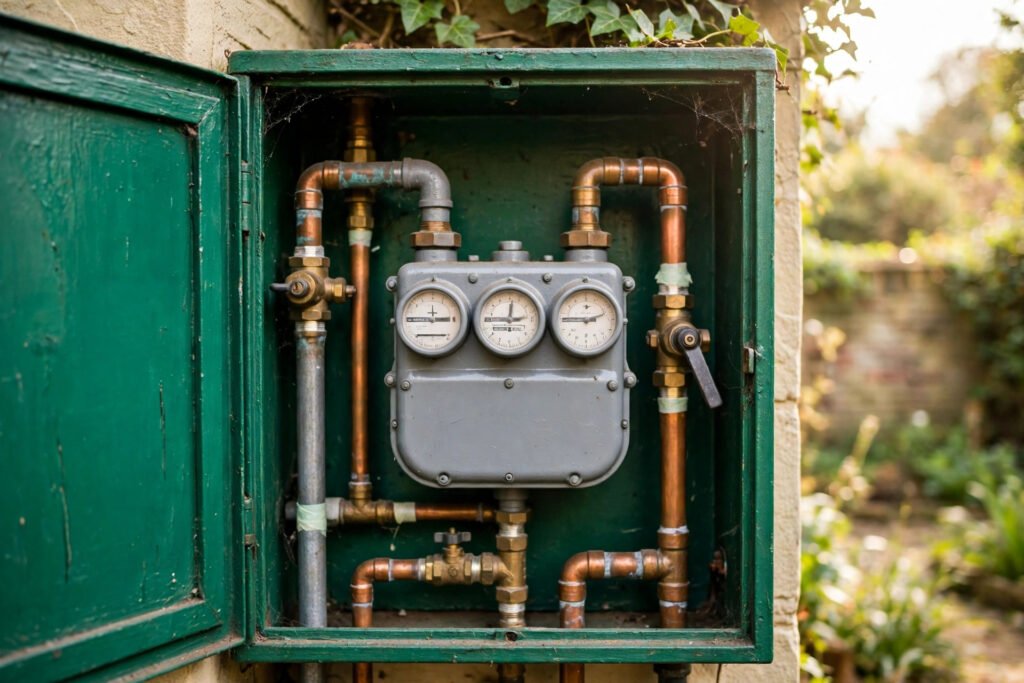
The standing charge covers the fixed costs of supplying your home, including:
- The network itself — maintaining and upgrading the cables, pipes, substations and pylons that carry energy across the country.
- Your meters — installing, reading, maintaining and replacing them, including the smart meter rollout.
- Connections and administration — the cost of keeping your account connected and supplied, and of moving energy data between companies.
- Government policy costs — some schemes funded through bills, such as the Warm Home Discount, are recovered partly through standing charges.
- Supplier failure costs — when a supplier goes bust, the cost of moving its customers to a new supplier has, in recent years, been spread across everyone’s standing charges.
Because most of these costs do not depend on how much energy you use, Ofgem’s price cap recovers them through the fixed daily charge rather than the unit rate. That design choice is exactly what makes the charge controversial.
Why standing charges are controversial
The obvious complaint is fairness. A low user — someone in a small flat, out at work all day, careful with heating — pays the same £308 a year in standing charges as a large household using five times as much energy. For low users, standing charges can make up a third or more of the total bill, which limits how much they can save by cutting back. It also blunts the reward for saving energy: even a household that halves its usage will see its bill fall by noticeably less than half.
Ofgem has reviewed how these fixed costs are recovered. One alternative is to load more of the cost onto unit rates instead, so heavier users pay more of the network bill — but that would raise prices for households with unavoidably high usage, such as those heating larger homes or running medical equipment. Another option being discussed is offering tariffs with lower standing charges and higher unit rates alongside standard ones, so customers can choose the shape that suits their usage. For now, though, the structure is unchanged: a substantial fixed charge is built into every tariff.
Standing charges and the price cap
Standing charges are part of the price cap, so they can change every three months along with unit rates. In the current period they are a significant slice of the £1,723-a-year cap figure for a typical household — the £308 of standing charges accounts for about 18% of it. When you read that the cap has gone up or down, it is worth checking whether the movement came from unit rates, standing charges, or both, because they affect different households differently. A rise in standing charges hits low users hardest; a rise in unit rates hits high users hardest.
You can see how the standing charge fits into a full bill in our breakdown of the typical bill for a 3-bed house.
Can you get a tariff with no standing charge?
Almost certainly not any more. A handful of “no standing charge” tariffs existed in the past, with the costs rolled into much higher unit rates for the first units used each day, but they have largely disappeared from the market and none of the major suppliers currently advertise one as a standard option. What does exist is variation: some fixed tariffs carry lower standing charges and higher unit rates, others the reverse. That is why comparing tariffs on unit rate alone is a mistake — a deal that looks cheap per unit can work out dearer once £300-plus of standing charges are added.
As a rule of thumb:
- Low users benefit most from low standing charges, even at a slightly higher unit rate.
- High users benefit most from low unit rates, even at a higher standing charge.
Our comparison of fixed vs variable tariffs explains how to run the numbers for your own household.
How to keep the cost down in practice
You cannot remove the standing charge while you remain connected, but you can stop it being a bigger share of your spending than it needs to be:
- Compare tariffs on both numbers. Use your annual usage in kWh and calculate the full year: (unit rate × usage) + (standing charge × 365), for each fuel.
- Do not pay more than you need to for a meter you barely use. If you have a gas supply you genuinely never use, ask your supplier about the cost and process of capping it — but think carefully, as reconnection is expensive.
- Watch the standing charge when your usage drops. If you install insulation, solar panels or a heat pump, your usage falls, and a low-standing-charge tariff may become the better deal even if its unit rate is higher.
- Check you are not paying twice. Moving home is the classic moment for errors — make sure the old property’s account is closed so you are not paying standing charges on two homes.
Frequently Asked Questions
Do I pay the standing charge on days when I use no energy?
Yes. It is charged per day of connection, not per day of use. A completely empty property with a live supply still accrues standing charges, which is why bills for vacant homes are never zero.
Why has my standing charge gone up?
Standing charges change when the price cap changes, and suppliers have also been recovering extra costs through them in recent years, including the cost of failed suppliers. Your tariff’s rates are set out on your bill — see how to read your energy bill for where to find them.
Is the standing charge the same with every supplier?
No. The price cap sets a maximum for default tariffs, and suppliers set their own charges at or below it. Fixed tariffs are not capped at all, so their standing charges vary more widely — another reason to check them before switching.
Will standing charges be abolished?
There is regular political and regulatory debate about reforming them, and Ofgem has consulted on alternatives, but as of October 2026 there is no confirmed plan or date for abolition. The costs they cover would still have to be paid somehow — most likely through higher unit rates.


[…] running at around SCOP 3 it can be the difference between matching gas and beating it. Our guide to standing charges explained covers how these daily charges […]
[…] something is wrong. Our energy price cap explained guide sets out exactly what the cap covers, and standing charges explained covers the daily fee in […]
[…] low users in particular. Always compare both numbers, not just the unit rate — our guide to standing charges explained shows how quickly they add up over a […]
[…] A few points from that table surprise people. Gas is the smaller cost per unit — 7.97p against 26.32p for electricity — but most homes use nearly four times as many units of it, mainly for heating and hot water, so gas ends up the bigger bill. And the standing charges add up to about £308 a year before you have switched on a single light. That fixed slice is unavoidable on any tariff, which is why we have a separate guide to standing charges explained. […]
[…] and you will pay more than the headline figure. Use less and you will pay less. Our guide to standing charges explained looks at that daily fee in more […]