
Boiler Not Working? 7 Checks Before You Call an Engineer
On this page
You wake up to a cold house, the radiators are stone cold and there is no hot water. Your first instinct is to call an engineer — but a fair number of boiler “breakdowns” turn out to be simple things: a tripped switch, a flat thermostat battery, low pressure. A typical repair costs around £300 on average according to Checkatrade, and emergency repairs average around £450, so fifteen minutes on the safe checks below is well worth it first.
Safety first — please read this before you start. Never open the boiler casing and never touch gas components, internal parts or the flue. Anything inside the boiler is a job for a Gas Safe registered engineer only. Every check in this article is done from outside the boiler, using the normal user controls. If you smell gas at any point, do not try these checks: turn off the gas at the meter if you can do so safely, open windows, leave the property and call the National Gas Emergency Service on 0800 111 999.
1. Check the power supply
A boiler needs electricity to run its controls, pump and fan, even though it burns gas. Look at the boiler’s display or indicator lights: if the unit is completely dead, check that the fused switch near the boiler is on, and then look at your consumer unit (fuse box) for a tripped switch. If the circuit keeps tripping when you reset it, stop there — repeated tripping suggests an electrical fault that needs a professional.
2. Check the thermostat and timer
This sounds obvious, which is exactly why it gets missed. Make sure your room thermostat is actually calling for heat: turn it up temporarily to a high setting and listen for the boiler firing. The Energy Saving Trust suggests most people are comfortable between 18°C and 21°C, so if your thermostat is set below the current room temperature, the boiler is doing exactly what it has been told to do. Check the programmer or timer as well — clocks that have drifted after a power cut, a heating schedule set to “off”, or a thermostat with flat batteries are all classic false alarms. Turning the thermostat up will not heat your home any faster; it simply confirms whether the boiler responds. For more on settings, see our guide to what temperature your home should be.
3. Check the boiler pressure
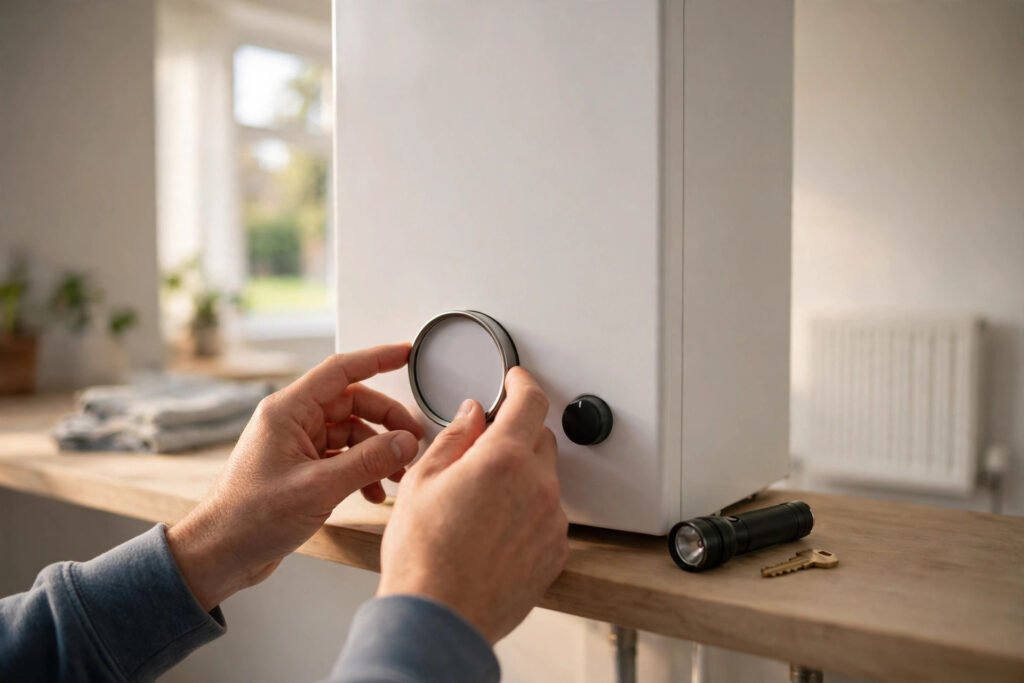
Find the pressure gauge or digital pressure reading on the front of the boiler. With the heating system cold, it should read between 1 and 1.5 bar. If it has dropped below 1 bar, the boiler may have locked out to protect itself, often showing a low-pressure fault code. Low pressure is common after bleeding radiators or if there is a small leak somewhere in the system.
You can top the pressure up yourself using the filling loop — the braided hose or built-in filling link by the boiler — following the instructions in your boiler manual for your exact model. Open the valves slowly, watch the gauge, and close them fully once the pressure reaches between 1 and 1.5 bar. If pressure keeps falling after topping up, do not keep repeating the process: a persistent drop points to a leak or an expansion vessel fault, which is engineer territory.
4. Try one reset — just one
Most boilers have a reset button or dial on the front panel, and the manual will show you where. If the boiler has locked out and is showing a fault code, make a note of the code, then press reset once and wait to see whether the boiler fires and stays running. If the same fault code comes straight back, do not keep resetting it. The lockout is a safety response to a real problem, and repeated resets will not fix it — that is the point at which an engineer needs to diagnose the cause.
5. Check for a frozen condensate pipe
In cold weather this is one of the most common causes of a boiler shutdown. Condensing boilers drain small amounts of water through a plastic condensate pipe, part of which often runs outside. In freezing temperatures it can ice up; the boiler detects the blockage and shuts down. You can thaw it by pouring warm — not boiling — water over the frozen section, or by applying a warm hot-water bottle. Once thawed, reset the boiler once. If it happens repeatedly each winter, ask an engineer about insulating or re-routing the pipe.
6. Check your radiators and their valves
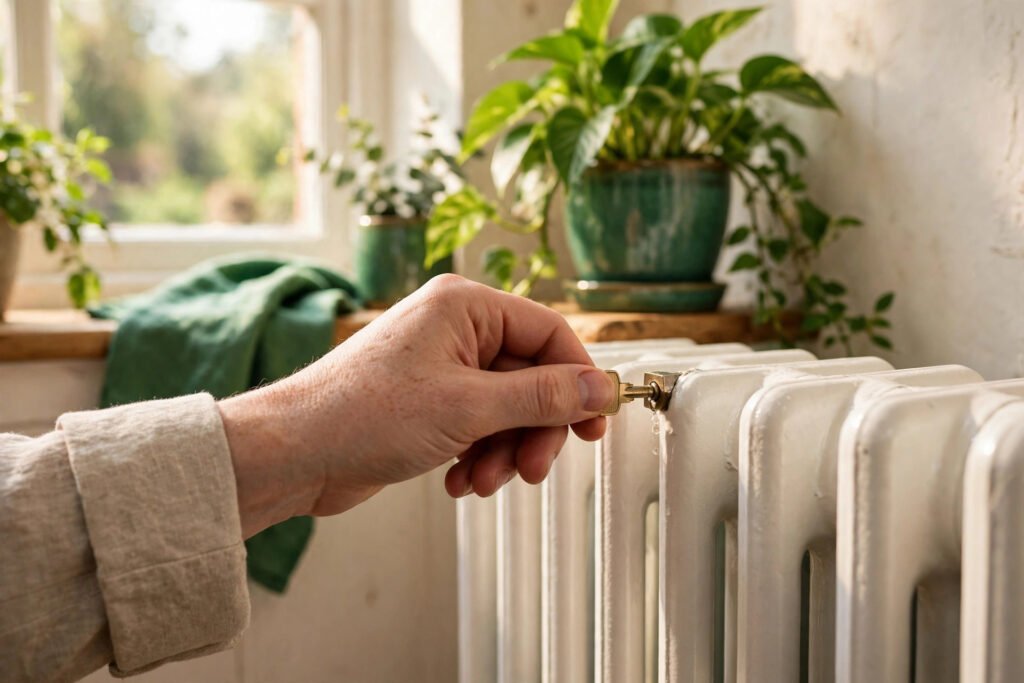
If the boiler is running but rooms are cold, walk around and feel the radiators. Radiators that are hot at the bottom and cold at the top usually have trapped air inside: you can bleed them with a radiator key, holding a cloth under the valve, until water appears. Check the pressure afterwards, as bleeding can lower it. Also check that radiator valves and thermostatic radiator valves (TRVs) are turned up in the rooms you are trying to heat — a TRV turned down in summer is another frequent false alarm. Radiators cold at the bottom but hot at the top can indicate sludge, which needs professional cleaning.
7. Check the gas supply
Finally, confirm the boiler actually has gas. If you have other gas appliances, such as a hob, try one: if none of them works, the problem is with the supply rather than the boiler. If you are on a prepayment meter, check you have credit and that the meter has not cut off the supply. Also make sure the boiler’s own gas isolation valve has not been knocked or turned off accidentally. If everything else in the house works and only the boiler will not fire, the fault is almost certainly inside the boiler — over to a Gas Safe registered engineer.
When to stop checking and call an engineer
Call a Gas Safe registered engineer straight away if you notice any of the following: water leaking from the boiler itself, scorch marks or unusual smells, the boiler repeatedly locking out after one reset, pressure that will not stay up, or any fault you cannot explain with the checks above. For context on what that visit might cost, Checkatrade puts typical boiler repairs at £120–£750 with an average of around £300, emergency repairs at £225–£675, and a routine boiler service at £80–£120. If the repair quote is large and the boiler is old, compare it against replacement using our guide to how much a new boiler costs — and if you are choosing a replacement, our combi vs system vs regular boiler comparison will help.
Conclusion
Work through the seven checks in order — power, thermostat and timer, pressure, one reset, frozen condensate pipe, radiators and valves, and gas supply — and you will either get the heating back on or be able to describe the problem precisely when you do call an engineer, which saves them time and you money. Stay firmly on the outside of the boiler, and leave everything internal to a Gas Safe registered engineer.
Frequently Asked Questions
Is it safe to reset my boiler myself?
Yes — using the reset button on the front panel is a normal user control. Press it once. If the boiler locks out again with the same fault code, stop resetting and call a Gas Safe registered engineer, because the boiler is reporting a fault that needs diagnosing.
What pressure should my boiler be?
Between 1 and 1.5 bar when the heating system is cold, as shown on the gauge or display. The reading will rise when the heating is running, which is normal. Below 1 bar is low and can cause the boiler to lock out.
How much does an engineer call-out cost if I do need one?
Checkatrade lists typical boiler repairs at £120–£750 including parts, with an average of around £300, and a gas engineer hourly rate of £50–£80. Emergency and out-of-hours repairs cost more, averaging around £450. Always confirm whether a diagnostic or call-out fee applies before booking.
My boiler works but one radiator stays cold. Is that a boiler fault?
Usually not. A single cold radiator points to that radiator: trapped air (bleed it), a TRV that is turned down or stuck, or sludge in that radiator. A boiler fault would normally affect the whole system or the hot water too.
[…] the property. Before any of this, if your current boiler has simply stopped, the checks in boiler not working? 7 checks before you call an engineer may save you an unnecessary decision altogether. And if you are weighing a boiler against newer […]
[…] the efficiency gap is factored in. If your boiler has stopped working today, try the safe checks in boiler not working? 7 checks before you call an engineer before paying for a […]