How Much Do Solar Panels Cost in the UK?
On this page
Solar panels are one of the biggest home improvements most people will ever price up, so it helps to know what a fair quote looks like before an installer visits. The good news is that costs have fallen over the past few years, and there is now solid official data to benchmark against. This guide breaks down what UK households typically pay by system size, what should be included in that price, and the extras that can quietly push a quote up.
The headline figure
According to the Energy Saving Trust, a typical domestic solar panel system is around 4.5 kilowatt peak (kWp) — roughly 12 modern panels — and costs around £7,600 to install. That figure covers a complete, professionally installed system, not just the panels themselves.
Data from MCS-certified installations, reported through government statistics, tells a similar story. Recent figures put the average installed cost at roughly £1,650 to £1,780 per kWp, depending on the period and region. Smaller systems cost more per kWp than larger ones, because fixed costs such as scaffolding and paperwork are spread over fewer panels. Use the per-kWp figure as your quickest sense-check: divide any quote by the system size, and you can immediately see whether it sits near the going rate or well above it.
Costs by system size
System size is measured in kWp — the maximum output of the array under standard test conditions. As a broad guide, expect installed prices in the following ranges. These are indicative market ranges for a straightforward roof installation, not guarantees for your home.
| System size | Typical installed cost | Who it usually suits |
|---|---|---|
| 2–3 kWp | Around £4,500–£6,000 | Smaller homes, lower electricity use, limited roof space |
| 4 kWp | Around £6,000–£8,000 | A typical two- to three-bedroom household |
| 4.5 kWp | Around £7,600 (Energy Saving Trust average) | The most common domestic size |
| 5–6 kWp | Around £7,000–£10,500 | Larger homes, higher daytime use, an electric vehicle or plans for one |
Notice that doubling the system size does not double the price. The panels themselves are only part of the bill, which is why a slightly larger system can sometimes be better value per unit of electricity generated — provided you can actually use or export the extra power. Our guide to whether solar panels are worth it shows how to judge that.
What should be included in the price?
A proper quote is a bundle, not a single line. The Energy Saving Trust lists the main elements of a typical installation, and you should expect most or all of the following to be itemised:
- The panels themselves, with the make, model and total kWp stated.
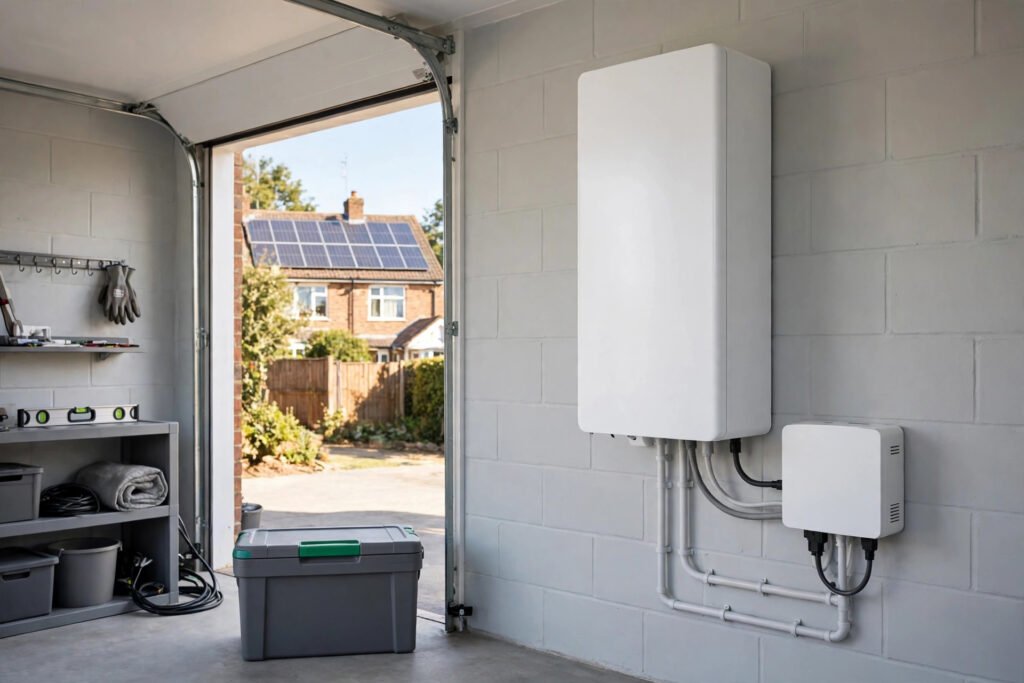
- The inverter, which converts the panels’ direct current (DC) into alternating current (AC) for your home. Panels should last 25 years or more, but an inverter typically needs replacing after around 12 years, so check its warranty — five years minimum is common, often extendable.
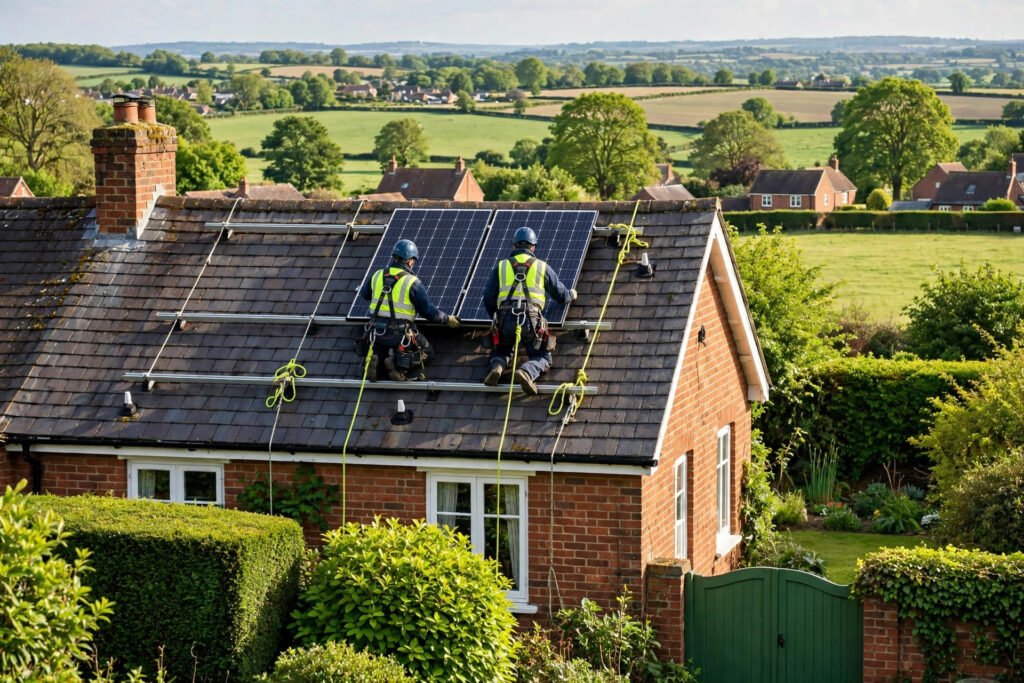
- Mounting equipment — the rails and brackets that fix the array to your roof.
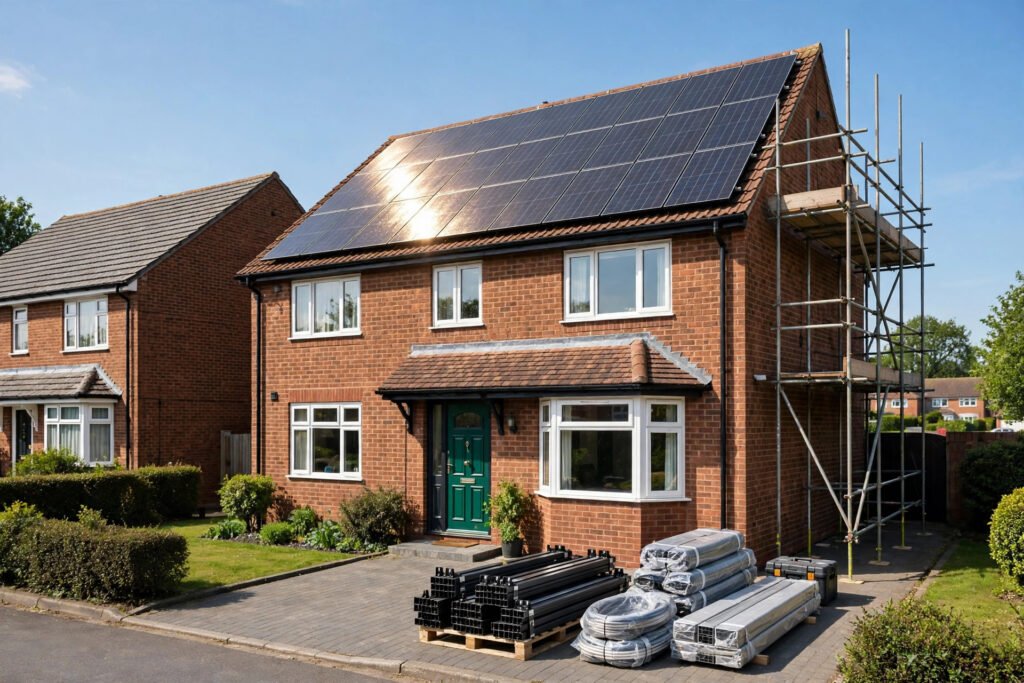
- Scaffolding or access equipment, which can be a significant cost on taller or awkward properties.
- Electrical work, including cabling, connection to your consumer unit, testing and certification.
- MCS certification and grid paperwork. Your installer should be MCS-certified; this matters because you need an MCS-certified installation to claim export payments under the Smart Export Guarantee. Systems also need to be notified to your Distribution Network Operator (DNO).
If scaffolding, the inverter or certification is missing from a quote, ask why before you compare it with others. A cheap headline price that excludes essentials is not cheap at all.
What pushes the price up or down?
Several factors move a quote away from the averages above. Roof access and complexity matter: multiple roof faces, fragile tiles or the need to renew roof coverings all add labour. Choosing solar tiles or panels integrated into the roof, rather than mounted on top, costs more. Location matters too, as labour rates are generally higher in London and the South East. Conversely, if you already have scaffolding up for other roof work, or you are building a new home, installation can work out cheaper because some costs are already covered.
Adding a battery at the same time also raises the total — storage typically adds several thousand pounds. We cover that separately in our guide to solar battery storage costs, including when it does and does not make financial sense.
VAT, grants and other help
Installation of solar panels in a home is currently zero-rated for VAT — 0% rather than the standard rate — under the government’s energy-saving materials relief. The zero rate is scheduled to run until 31 March 2027, after which a reduced rate of 5% is due to apply. Your installer applies the correct rate on the invoice, so quotes you receive now should already reflect 0% VAT on the installation.
There is no dedicated UK Government grant just for solar panels, and the Boiler Upgrade Scheme does not cover them — that scheme is for heating systems such as those in our heat pump cost guide. Some households on lower incomes may get solar funded as part of wider schemes, such as the Warm Homes: Local Grant in England for eligible homes, so it is worth checking what your local council offers.
How to compare quotes fairly
The Energy Saving Trust recommends getting quotes from at least three MCS-certified installers. When you compare them, check that each quote states the same system size in kWp, names the panel and inverter models, includes scaffolding and certification, and gives a site-specific estimate of annual generation for your roof. Be wary of any installer who promises exact savings — honest estimates come with assumptions about your roof, your usage and energy prices, all of which vary.
Conclusion
For most UK homes, budget around £7,600 for a typical 4.5 kWp system, or roughly £1,650–£1,780 per kWp as a cross-check on any quote. Get three itemised quotes from MCS-certified installers, confirm exactly what is included, and remember that the cheapest quote is only good value if the equipment, warranties and paperwork are all in place.
Frequently Asked Questions
How much does one solar panel cost?
Individual panels are rarely priced on their own in a domestic quote, because the inverter, mounting, scaffolding and labour make up much of the total. It is more useful to compare the full installed price per kWp, which recent MCS data puts at roughly £1,650–£1,780.
Is VAT charged on solar panels?
Not on a qualifying home installation at present. Installing solar panels in residential accommodation is zero-rated for VAT until 31 March 2027, after which the rate is scheduled to rise to 5%. Buying panels alone, without installation, is treated differently, so most households benefit by having one installer supply and fit the system.
Does a bigger system always cost more per panel?
No — usually the opposite. Because scaffolding, electrical work and paperwork are largely fixed costs, larger systems tend to work out cheaper per kWp than smaller ones. The catch is that extra capacity only pays if you use or export the additional electricity.
How long does installation take?
The physical installation of a standard rooftop system is typically completed within a few days once scaffolding is up, although surveys, ordering and grid paperwork mean the whole process from signing to generating usually takes longer. Your installer should give you a timetable before you commit.
Do I need planning permission?
Most houses can install roof-mounted panels under permitted development rights, provided limits on height and projection are met. Listed buildings, some conservation areas and flats have extra rules, so check with your local planning authority if any of those apply to you.